


The Silent Ransom Community extortion gang is actively concentrating on U.S. laws firms and skilled products and services organizations in social engineering assaults that generally lead to knowledge theft within hours of initial contact, basically basically based on a up to date myth by cybersecurity firm Mandiant.
The myth follows an FBI FLASH advisory published final week warning that the Silent Ransom Community became concentrating on U.S. laws firms in social engineering and even in-person knowledge theft assaults, with Mandiant now providing additional technical necessary ingredients about how the intrusions are performed.
Mandiant says the possibility neighborhood, tracked as UNC3753, Luna Moth, and Chatty Spider, focused dozens of organizations all one of the best draw by the precise, monetary, and skilled products and services sectors between January and Might well per chance moreover 2026.

Mandiant warned that precise firms remain especially elegant targets ensuing from they retailer gargantuan volumes of highly gorgeous client knowledge and would possibly per chance presumably presumably per chance in actual fact feel forced to salvage to the bottom of extortion incidents to handbook droop of reputational and regulatory anxiousness.
"Legal services firms represent high-value targets for extortion actors. They maintain concentrated repositories of extremely sensitive client transaction files, merger and acquisition plans, client trade secrets, and corporate regulatory reports," explains Mandiant.
"Threat groups recognize that legal entities are subject to heavy reputational and regulatory exposure and may be highly motivated to resolve extortion situations quietly to protect their professional standing."
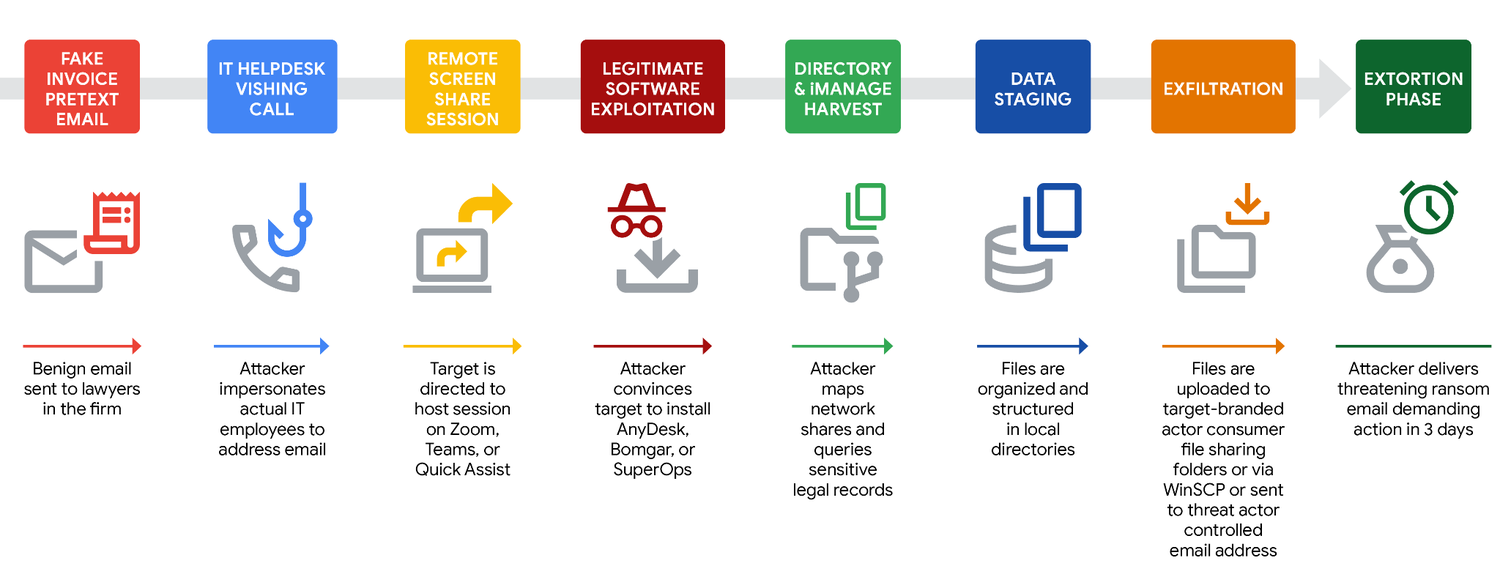
The researchers deliver the assaults birth with bill-themed phishing emails from consumer electronic mail accounts. These emails construct no longer maintain malicious links or attachments and in its set aside back as a precursor for follow-up phone calls from attackers impersonating corporate IT workforce.
Conducting assaults by strategy of utter calls has been an ongoing tactic by these possibility actors for years, which they beforehand dilapidated in BazarCall social engineering campaigns tied to Ryuk and Conti ransomware assaults. A callback phishing assault is when possibility actors send benign-looking phishing emails containing alarming or IT-connected lures that urged the recipient to call them encourage at an enclosed phone quantity.
In the latest campaign, the Silent Ransom Community impersonates IT aid desks and convinces workers to affix some distance away reduction sessions by strategy of Microsoft Groups, Zoom, Mercurial Befriend, or Microsoft Terminal Services and products.
All one of the best draw by these sessions, the possibility actors trick the goal into placing in some distance away monitoring and administration instruments equivalent to AnyDesk, Zoho Befriend, Bomgar, or SuperOps, thereby granting them initial salvage admission to to the corporate network.
Mandiant moreover chanced on phishing domains tied to the campaign that impersonate inside of IT portals utilizing naming patterns equivalent to:
-itdesk[.]com
-it[.]com
-helpdesk[.]com
The researchers deliver the possibility actors moreover exercise privnote[.]com, a self-destructing messaging provider, to share set up links and instructions with targets right by some distance away reduction sessions. Based totally totally on Mandiant, this tactic helps decrease forensic artifacts left in browser histories or corporate chat logs.
As soon as inside of a network, the neighborhood searches for gorgeous precise and monetary paperwork, alongside side contracts, tax files, Social Safety numbers, and merger or acquisition files. The attackers continually goal doc administration platforms and cloud storage repositories sooner than exfiltrating the solutions utilizing instruments equivalent to WinSCP or Rclone.
Mandiant says the extortion operation is extremely aggressive, with ransom demands generally arriving within half-hour of the attackers leaving the victim atmosphere.
"These highly aggressive extortion letters give organizations a three-day deadline to respond and initiate ransom negotiations. If the victim organization is unresponsive, the threat actors declare they will call and email target employees and external clients directly to alert them of the data breach," experiences Mandiant.
"The extortion letters explicitly emphasize that the leak will compromise client trust, invite substantial regulatory fines, and suggest that external clients sue the victim organization for data mishandling."
The myth moreover references the FBI's latest advisory in which laws enforcement warned that the Silent Ransom Community became concentrating on U.S. laws firms with in-person knowledge theft assaults.
Based totally totally on the FBI, attackers impersonate inside of IT workforce over phone calls and emails, then are trying to reach some distance away salvage admission to or bodily visit offices to "image" computer systems or manufacture backups while secretly stealing files.
While Mandiant mentioned there became restricted forensic proof, the researchers think these in-person assaults are probably linked to UNC3753 in line with similarities in concentrating on, timelines, and operational behavior.
The Silent Ransom Community has been active since a minimal of 2022, when it became fraction of the Ryuk and Conti cybercrime syndicate.
As beforehand reported by BleepingComputer, the possibility actors had been beforehand linked to BazarCall callback phishing campaigns that equipped initial salvage admission to in Conti and Ryuk ransomware assaults.
After the Conti syndicate shut down in 2022, the neighborhood shifted to standalone knowledge theft and extortion operations below the Silent Ransom Community branding.
Researchers deliver the neighborhood now no longer relies on archaic ransomware encryption and in its set aside focuses fully on knowledge-theft extortion, in which they rob gorgeous knowledge and stress victims into paying to pause leaks.
A separate myth launched this week by Resecurity chanced on that the crowd is moreover running immediate-flux infrastructure to cloak and offer protection to its knowledge-leak platforms.
DNS immediate flux is a style the set aside attackers constantly rotate a domain's IP addresses by a gargantuan pool of compromised units to cloak their infrastructure and manufacture takedowns or blocking great more refined.
Based totally totally on the firm, the infrastructure makes exercise of residential IP addresses all one of the best draw by a pair of countries and ISPs to manufacture takedowns more refined.
Resecurity mentioned the neighborhood's "business-data-leaks[.]com" leak set aside of living and connected infrastructure rely on residential proxy networks spread all one of the best draw by Latin The United States, Jap Europe, Central Asia, the Middle East, and Asia. The researchers moreover linked the infrastructure to other cybercrime-connected products and services and domains.
To defend in opposition to the assaults, both Mandiant and the FBI counsel implementing strict verification procedures for IT reduction interactions, limiting some distance away salvage admission to instruments, imposing MFA, limiting USB storage units, and training workers to leer utter phishing makes an strive.
For organizations seeking to defend in opposition to phishing, BEC, and account takeover assaults, BleepingComputer is knowledge superhighway web hosting a webinar with Extraordinary titled "Terminate chasing indicators: Automating electronic mail safety with behavioral AI."
The webinar will stumble on how behavioral AI can aid safety teams detect and reply to traditional phishing assaults, automate investigations and remediation, and decrease the operational burden brought about by alert fatigue and increasingly more refined social engineering campaigns.

Private detective Take a look at every layer sooner than attackers construct
Safety teams log 54% of a success assaults and alert on appropriate 14%. The comfort accelerate by your atmosphere unseen.
The Picus whitepaper reveals how breach and assault simulation tests your SIEM and EDR principles so threats pause slipping by detection.
Read Extra


